Breast fed is best
Breast milk is the normal way to feed a baby and is important for baby’s health. Professional advice should be followed before using an infant formula. Introducing partial bottle feeding could negatively affect breast feeding. Good maternal nutrition is preferred for breast feeding and reversing a decision not to breast feed may be difficult. Infant formula should be used as directed. Proper use of an infant formula is important to the health of the infant. Social and financial implications should be considered when selecting a method of feeding.
Like cow milk, goat milk requires the addition of lactose to reduce levels of protein and minerals. Some added essential fatty acids, folic acid, vitamins B12, C, D, E, iron is also necessary.
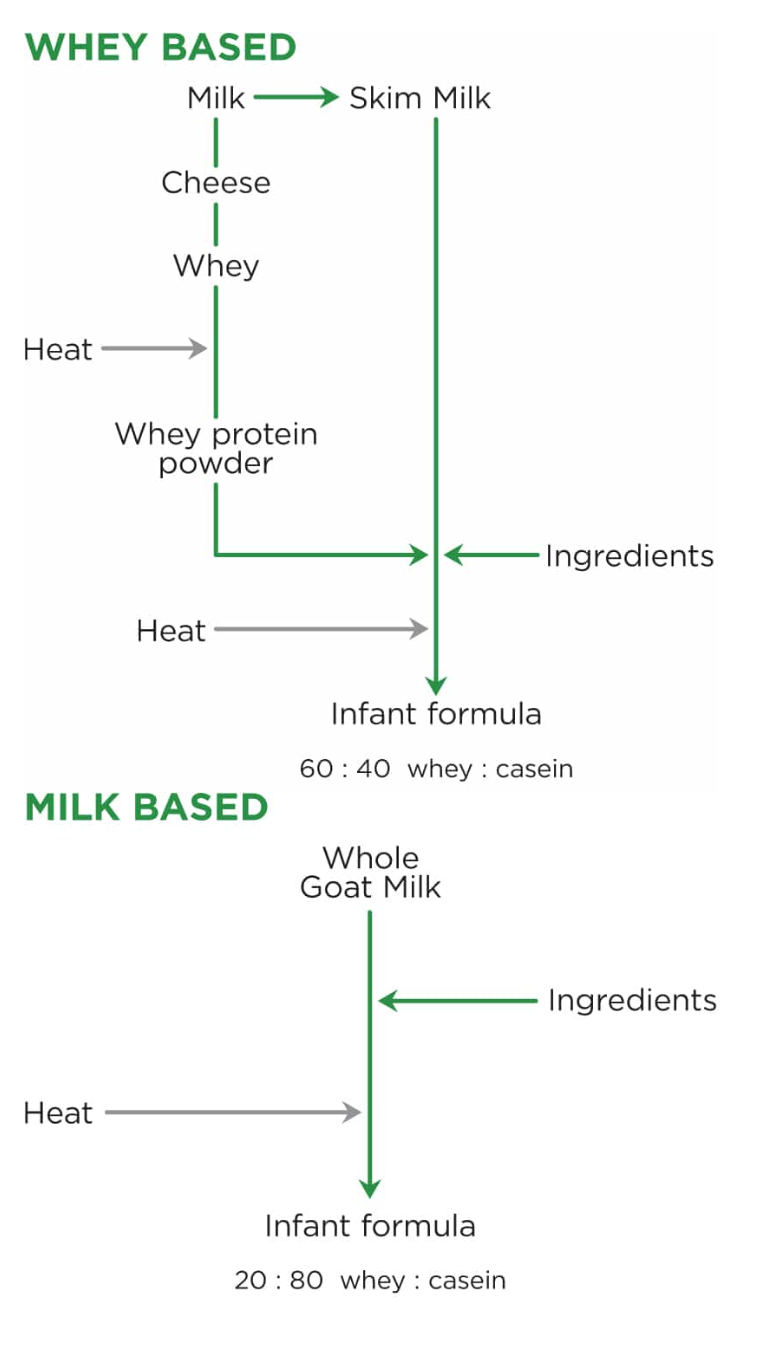
When making formula from cow milk, many formula manufacturers add extra process steps to remove and replace the milk fat, extract and add whey proteins plus ingredients like nucleotides or oligosaccharides.
Addition of whey proteins to cow milk is favoured by many formula manufacturers to improve the supply of essential and semi-essential amino acids.1 However, DGC’s research confirms whey is not necessary for formula made from goat milk. Goat milk only requires the addition of very small amounts of two amino acids to supply all the essential and semi-essential amino acids needed for infants.2 Many formulas also have the fat from milk replaced with vegetable oils.3
At DGC our process begins with whole goat milk to retain the milk fat before adding lactose, essential fatty acids, vitamins and minerals. Some vegetable oils are still required to top up the essential unsaturated fatty acids in goat milk,4 but the goat milk fat is not removed. The inclusion of goat milk fat retains the medium chain saturated fatty acids in goat milk,5 which are more readily absorbed by infants than long-chain saturated fatty acids.6
The use of whole goat milk also means that nucleotides7 that are already higher in goat compared to cow milk are also retained. As a result, there is no need to add nucleotides when making formula from whole goat milk.
Goat milk may smell of goats if the milk fat is damaged. DGC has developed ways to reduce any damage to the milk fat to prevent any goat smell from developing. This includes strict guidelines for what animals are fed, how they are milked and rapid cooling of milk until it is processed. In addition, the formula making process has also been designed to prevent damage to the goat milk fat in the formula.
- 1Janas et al. 1987; Lönnerdal and Chen, 1990; Karlsland Åkesson et al, 1998
- 2Rutherfurd et al. 2006; Rutherfurd et al. 2008; EFSA 2012
- 3Delplanque et al, 2015
- 4Prosser et al, 2010
- 5Prosser et al, 2010
- 6Jensen et al 1986; Lindquist & Hernell, 2010
- 7Prosser, McLaren et al. 2008; Gill, Indyk and Manley-Harris, 2012