
Dairy Goat Co‑operative products are made using WGF™
WGF™ is our whole goat milk formula with a carefully balanced composition—and that’s what sets us apart.
Unlike many formulas that use skim milk and then add fats back in, we keep the natural goodness of our whole goat milk intact.
Whole Goat Milk Formula (WGF™) means:
- ~50% Milk Fat – Naturally present, not artificially added.
- Gently Processed – Made with care using only fresh whole goat milk.
- No Added Whey – This means no added beta‑lactoglobulin, one of the proteins commonly associated with allergic response.
If you want to find our products, look for the lockup or find them at our leading brands here
A naturally soft protein
Goat milk, like human milk, is naturally lower in a protein called αS1-casein, compared to cow’s milk1,2. This leads to a naturally softer curd being formed in the stomach3, meaning goat milk is naturally easy to digest and, unlike cow’s milk formula, requires no whey addition to support digestibility in infants.
Goat and cow whey protein contain beta-lactoglobulin1,2, a key milk allergen not present in human milk. By not adding whey, levels of this allergen can be minimised, and together with the lower levels of αS1-casein, another key allergen, the overall allergic load in whole goat milk formula is lower than standard, whey-adjusted cow milk formula. The protein in goat milk is also naturally A2, meaning it contains only A2-type beta-casein and no A1-type beta-casein4.
The digestion and absorption of amino acids in whole goat milk formula are similar to those of whey-adjusted cow infant formula5. Infants fed whole goat milk and whey-adjusted cow infant formula had no significant differences in plasma amino acid concentrations6.
Levels of αS1-casein are lower in goat milk compared to cow milk
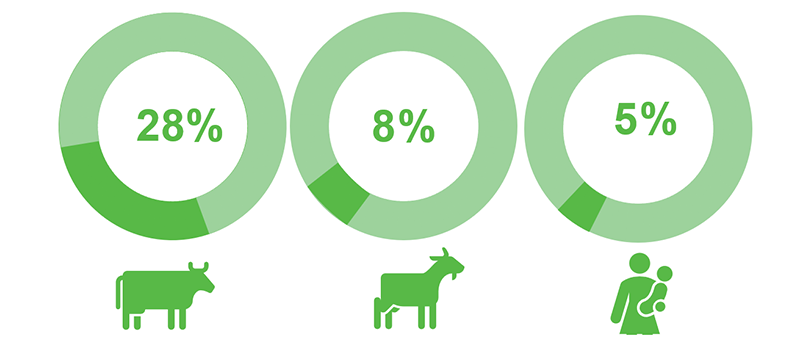
alpha-S1 casein as % of total protein
A natural source of milk fat
Our whole goat milk formula also contains around 50% of the fat as goat milk fat, delivering key components such as sn-2 palmitic acid, milk fat globule membrane (MFGM) and cholesterol. MFGM is rich in phospholipids, sphingolipids and cholesterol, which play a role in brain development, and contains bioactive proteins linked to immune function7,8. Goat milk fat also delivers higher levels of palmitic acid in the sn-2 position, which has been linked to softer stools and easily absorbed medium-chain fatty acids, compared to standard cow milk formula, which mostly contains vegetable oils6.
Milk Fat Globule Membrane

| 1 | Li, S., Delger, M., Dave, A., Singh, H., & Ye, A. (2022). Seasonal variations in the composition and physicochemical characteristics of sheep and goat milks. Foods, 11(12), 1737. |
| 2 | Amalfitano, N., Rosa, G.J.M., Cecchinato, A., & Bittante, G. (2021). Nonlinear modeling to describe the pattern of 15 milk protein and nonprotein compounds over lactation in dairy cows. J Dairy Sci, 103, 11190-11208. |
| 3 | Wang, Y., Eastwood, B., Yang, Z., et al. (2019). Rheological and structural characterization of acidified skim milks and infant formulae made from cow and goat milk. Food Hydrocolloids, 96, 161-170. |
| 4 | Rahmatalla, S.A., Arends, D., & Brockmann, G.A. (2022). Review: Genetic and protein variants of milk caseins in goats. Front Genet, 13, 995349. |
| 5 | Rutherfurd, S.M., Darragh, A.J., Hendriks, W.H., Prosser, C.G., & Lowry, D. (2006). True ileal amino acid digestibility of goat and cow milk infant formulas. J Dairy Sci, 89(7), 2408-2413. |
| 6 | Zhou, S., Sullivan, T., Gibson, R.A., et al. (2014). Nutritional adequacy of goat milk infant formulas for term infants: a double-blind randomised controlled trial. Br J Nutr, 111(9), 1641-1651. |
| 7 | Gallier, S., Tolenaars, L., & Prosser, C. (2020a). Whole goat milk as a source of fat and milk fat globule membrane in infant formula. Nutrients, 12, 3486. |
| 8 | Demmelmair, H., Presll, C., Timby, N., & Lönnerdal, B. (2017). Benefits of lactoferrin, osteopontin and milk fat globule membranes for infants. Nutrients, 9, 817. |